
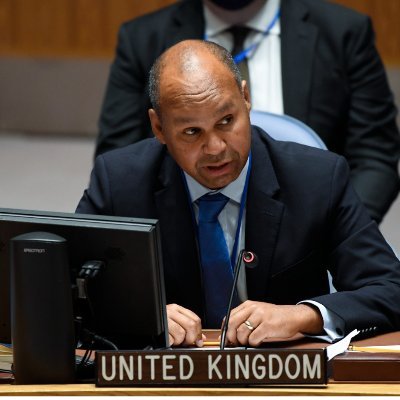
The United Kingdom has urged West African and Sahel countries to deepen regional security and political cooperation in response to the escalating threat of terrorism across the region.
Speaking at a UN Security Council session, UK Chargé d’Affaires, Ambassador James Kariuki, warned about the rapid expansion of Islamic State and Al-Qaeda affiliates and their increasing impact on civilians. He cited the recent fuel blockade in Mali by Al-Qaeda-linked JNIM as evidence of the groups’ evolving tactics.
Kariuki outlined three priorities for tackling the crisis.
First, he called for stronger regional collaboration, commending improved engagement between ECOWAS and AES states and UNOWAS’s role in facilitating dialogue. He highlighted regionally led efforts such as plans for a standby rapid deployment force, the Multinational Joint Taskforce, and ECOWAS’ Counter-Terrorism Strategy. He also noted that UN Security Council Resolution 2719 could help support AU-led peace operations.
Second, he reaffirmed the UK’s commitment to African-led solutions, pointing to British support for Nigeria’s National Counter-Terrorism Centre, Côte d’Ivoire’s Counter Terrorism Academy, and the Regional Intelligence Fusion Unit. These partnerships, he said, are strengthening intelligence sharing and regional resilience. Kariuki also cautioned countries to choose security partners wisely to avoid worsening instability.
Finally, the UK stressed the need to address root causes of terrorism by improving governance, reducing poverty, combating disinformation, safeguarding civic space and responding to climate pressures. Without progress, Kariuki warned, extremist violence will continue to devastate communities, especially women and children.
Terrorist groups linked to IS and Al-Qaeda have expanded rapidly in the last decade, exploiting weak state systems and local grievances. Mali, Burkina Faso and Niger remain among the hardest-hit, suffering repeated attacks, mass displacement and rising civilian casualties.
